- Sbig Usb Devices Driver Adapter
- Sbig USB Devices Driver
- Sbig Usb Devices Driver Updater
- Sbig Usb Devices Driver Wireless

- The USB drivers help us to connect our phone to the computer and perform tasks like transferring data, syncing your device with a PC. They help us to connect our Android devices to tools like Odin, Sony Flash tool, and SuperOneClick.
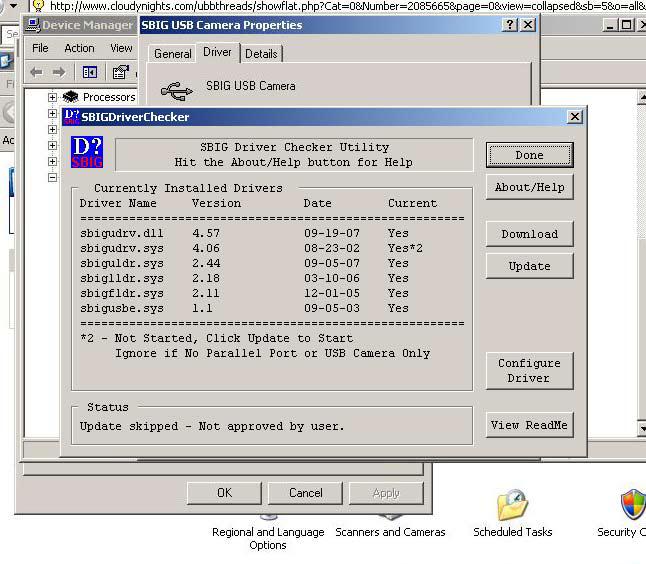
- The SBIG Universal Driver is distributed via SBIG Driver Checker 64 on Windows, and via an installer on Mac OSX. Keeping your drivers up to date is the best way to ensure your camera runs smoothly, so remember to update your drivers regularly. Download (Win) Download (OSX) CCDOps. CCDOPS is a free program that operates USB based SBIG cameras.
- Software Bisque's CCDSoft version 5.xx is Windows software for SBIG serial, parallel and USB based cameras (except STV). It integrates with Software Bisque's other software packages like TheSky™ and Orchestrate.
Improvements and fixes. This update includes a fix for an incorrect device driver (“Microsoft – WPD – 2/22/2016 12:00:00 AM - 5.2.5326.4762”) that was released by a third-party on March 8, 2017 that affected a small group of users with USB connected phones or other media devices that rely on Media Transfer Protocol (MTP).
In order to manually update your driver, follow the steps below (the next steps):
1. Go to Device Manager (right click on My Computer, choose Manage and then find Device Manager in the left panel)
2. Right click on the hardware device you wish to update and choose Update Driver Software
3. Choose to select the location of the new driver manually and browse to the folder where you downloaded the driver
About USB Drivers:
In order for your phone to communicate with your PC, you need to install the proper USB drivers and connect the two via a USB cable. Your operating system may automatically install a generic USB driver, but these are often limited and do not offer the full range of features that drivers custom-tailored for your mobile phone usually offer.
It is highly recommended that you uninstall any previous Phone to PC USB drivers you may already have on your personal computer, because they may interfere with the installation process.
Most mobile phones come with an installation CD with software applications, including the USB driver that you need. You might not be interested in installing the Software Suite but, unfortunately, there is no workaround for some devices, and the only way to install the USB drivers is by installing the provided software.
When the software is outdated, it can cause problems when trying to get your device recognized by the computer. In this case, you should try to download the driver separately, making sure you choose the one that is specifically made for your device.
Make sure you regularly check with our website for new drivers so that you won't miss any updates.

It is highly recommended to always use the most recent driver version available.
Try to set a system restore point before installing a device driver. This will help if you installed an incorrect or mismatched driver. Problems can arise when your hardware device is too old or not supported any longer.
- COMPATIBLE WITH:
- Windows XP
Windows Vista
Windows XP 64 bit
Windows Vista 64 bit
Windows 7
Windows 7 64 bit
Windows 8
Windows 8 64 bit - file size:
- 4.3 MB
- filename:
- 20454397_e6970b8fe6fbd5a30515a2c08724d81c8666e972.cab
- CATEGORY:
- Mobile Phones
For this driver, please select SBIG Universal on the Setup tab.
This driver supports all SBIG USB and Ethernet cameras supported by the Generation 2 'SBIG Universal' drivers. This includes the modern ST-I, STF, STT, STXL and STX camera models and their filter wheels. It also supports older ST and STL camera models that have USB interfaces, and their associated filter wheels.
For Generation 2 'SBIG Universal' cameras using the AO-8, AO-8T, AO-L, or AO-X adaptive optics accessories, please use the SBIG w/ AO driver instead.
For Generation 3 cameras such as Aluma, with or without AO accessory, please select DL Imaging instead.
The latest version of the SBIG camera drivers are required. You can download them from http://www.sbig.com
Some SBIG cameras are capable of being operated in TDI mode.
Sbig Usb Devices Driver Adapter
For Ethernet connection, select Ethernet and enter the correct IP Address for the camera. The IP Address is ignored when connecting to a USB camera. To connect to a camera using USB, simply select the camera name from the Connect Todropdown.

Swap Chips, when activated, reverses the main sensor and autoguider sensor.
The Guide Chip setting is used to select between the internal guide chip and the separate Remote Guide Head that is available as an option for many SBIG cameras . Select the Internal setting to use the guide chip that is built in to the main camera body. Semc japan driver download. Select External Remote to use a separate 'guide head'.
Ext. Trigger enables the external trigger mode. When on, the camera will not start exposing immediately when the Expose button is clicked. Instead, the camera will wait until an external trigger signal is received. Only certain models support this feature. Contact SBIG for information on connecting an external trigger.
When using the integrated autoguider, which includes any 'external guide head' controlled through the camera, turn on the Dual Chip Mode check box on the Setup tab.
A set of Advanced settings are also available for the camera. These settings can be changed using the camera setup dialog, before connecting, or changed while connected using the Options button on the Settings tab of the CCD Control Window.
A variety of Readout Settings are available. Guider ABG affects the anti-blooming control for the autoguider CCD only (supported by older guiders with TC-211 or TC-237 sensors only). Anti-blooming for the main CCD is determined by the type of CCD chip installed in the camera.
Setting Binning Mode to Off-chip is useful when a non-anti-blooming CCD chip is installed. When enabled, it causes any binning to be performed after the CCD chip has been read (normally, binning is done inside the CCD chip before readout). Selecting this option results in slightly higher readout noise but greatly reduces blooming. This control has no effect for anti-blooming CCD chips, and has no effect for 1:1 binning. You can also set Binning Mode to Spectroscopy. In this mode, the main sensor can be binned Nx1 to Nx3, where N ranges from 1 to 255.
The DownloadPriority can be adjusted. Very High will ensure that no lines appear in the image due to readout delays, but may make it difficult to operate the mouse. Higher priority downloads may improve image quality on older cameras that do not have a built-in frame buffer.
Auto-Expose After Filter Change may be useful for clearing the array if rotating the filter wheel causes IR light strike on the sensor. This may be useful for the lower-cost and older filter wheel models (STT, STX, and STXL filter wheels do not use IR sensors).
If the DSS Control check box is checked, the DSS Control dialog will be displayed as soon as the user connects to the camera. If already connected, checking the DSS Control option causes the DSS Control dialog to appear, and unchecking it hides the dialog. This dialog is useful when the camera is used in conjunction with a Deep Space Spectrograph. See below for details on the DSS Control dialog.
RBI Preflash can be used to remove Residual Bulk Image by pre-flashing the array with infrared light and then flushing. Flash Length (s) controls the preflash duration in seconds, and Flush Count determines how many flush cycles to perform after the preflash. Default loads the default settings. These settings are only available when connected to a camera supporting these settings (firmware update may be required).
Readout Modes allows you to select Dual Channel Mode for cameras that have dual readout capability, and TDI Mode for camera models that can do Time Domain Integration (drift scanning). In TDI mode rows are read out of the camera continuously at a specified rate while the shutter remains open. For astronomical applications, TDI is used to capture a wide (E-W) swath of the sky using a fixed camera. When the camera is connected in TDI mode, the Camera Control window displays an additional TDI Tab.
The Color Conversion settings are enabled if you are not currently connected, or if you are connected to a one-shot color camera such as the ST-IC or STF-8300C. Debayer Mode selector allows you to choose the algorithm used for automatic color conversion. Fast mode produces reasonable color quality at a decent speed. High-Quality mode takes longer to convert the image, but produces images with fewer artifacts from the conversion process.
The Scaling % adjustments allow you to compensate for differing sensitivity between the color planes. You can adjust these while imaging a grey card or the Moon to remove the majority of any intrinsic color imbalance in the camera. Values of 100% result in no change. The scaling values can be typed in or adjusted using the spin controls.
Sbig USB Devices Driver
The X Offset and Y Offset selections are used to correct for any misalignment of the color mask in the CCD camera. If Auto Color images exhibit a completely incorrect color rendition, try selecting different combinations of these two options.
Fan Control includes Enable Fan for models that have fan on/off control. In addition, Fan Speed adjustment is available for models that have adjustable fan speed. The Auto selection allows the camera to select the fan speed based on cooler power level. You can also set the fan speed manually. Reducing fan speed will reduce audible noise, and in rare cases vibration, but will reduce the effectiveness of sensor cooling.
The DSS Control dialog allows you to change the current mode of operation of a Deep Space Spectrograph. Clicking the Position Mode button moves the DSS slit out and configures the grating to show the image. Clicking the View Slit Mode button moves the DSS slit into position and configures the grating to show the image. Clicking the Grab Spectra Mode button moves the DSS slit into position and configures the grating to show the spectra.
Exposure Flags: Turning on Wait For Ext Trigger will cause the exposure to wait until the external trigger input is seen by the camera. The exposure is started normally in MaxIm DL, but will not actually start until the trigger input is detected. Refer to the camera manual for information on connecting an external trigger. Please note that some models do not support external triggering.
Drivers pixma mg2522. Windows 7 (drivers only) Windows 8 (drivers only) Windows 8.1 (drivers only) Windows 10 (drivers only) User Guide Quick installation guide Release Notes: V1.0.1: May 15, 2015: Windows 7, 8 and 8.1 (drivers only) User Guide Quick installation guide Release Notes: V1.0.0: April 6, 2015: Windows 7, 8 and 8.1 (drivers only) User Guide Quick. Proxim offers you wireless support in the form of support programs, live chat, training & product warranty registration services to protect your network investment. Whether on building sites, in high-speed vehicles or at any location where installing cabling is not an option, then wireless capable of delivering jitter free high-bitrate video is the only option. Proxim delivers the best possible video quality across long distance without wasting bandwidth.

Sbig Usb Devices Driver Updater
Customer Options: Turning on Use Window Heater will activate the window heater for models that support this feature. This is used as an anti-fog measure and should only be used if the camera is exposed to a high humidity environment causing the external surface of the chamber window to fog up. If any fogging is observed inside the chamber then the desiccant module needs to be recharged per the camera instruction manual. (Note: Permitting significant moisture accumulation inside the chamber can corrode the sensor or other circuitry and will void your warranty. Be sure to refresh the desiccant plug annually, especially if you are operating in a high humidity environment.)
Important Note: Some SBIG cameras contain interline CCD sensors that can be electronically shuttered, allowing them to achieve shorter exposures than frame-transfer chips, where the exposure duration is limited by the speed of the shutter. Unfortunately, the camera electronics behave differently for short exposures than for longer exposures, producing different bias patterns in the camera images. To successfully calibrate images from these cameras, bias frames cannot be used to calibrate images whose duration is shorter than .12s. These short duration images must be dark subtracted using a dark frame of the same duration as the light frame. Similarly, dark frames exposed for less than .12s cannot be scaled to match light exposures of a longer duration. For longer exposures, all of the calibration options work normally.
Note: The plug-in nominally supports TDI rates from 1 msec to 5 sec per row. However the fastestusablerate is determined by the speed of your computer, and the slowest by the dark current of your camera. With a USB camera on a 1GHz or faster computer, TDI will normally operate well using focal lengths from 400mm to 4000mm.
Sbig Usb Devices Driver Wireless
Availability of this feature depends on Product Level.